Understanding Belief Formation
Descarga y escucha en cualquier lugar
Descarga tus episodios favoritos y disfrútalos, ¡dondequiera que estés! Regístrate o inicia sesión ahora para acceder a la escucha sin conexión.
Understanding Belief Formation
Esta transcripción es generada automáticamente. Ten en cuenta que no se garantiza una precisión absoluta.
Descripción
http://theconversation.com/what-delusions-can-tell-us-about-the-cognitive-nature-of-belief-243627 The Conversation, By Michael Connors and Peter W Halligan, on November 19, 2024 http://theconversation.com/what-delusions-can-tell-us-about-the-cognitive-nature-of-belief-243627 This episode of The Non-Prophets explores the intricate relationship between belief, delusion, and religious convictions....
mostra másThe Conversation, By Michael Connors and Peter W Halligan, on November 19, 2024
http://theconversation.com/what-delusions-can-tell-us-about-the-cognitive-nature-of-belief-243627
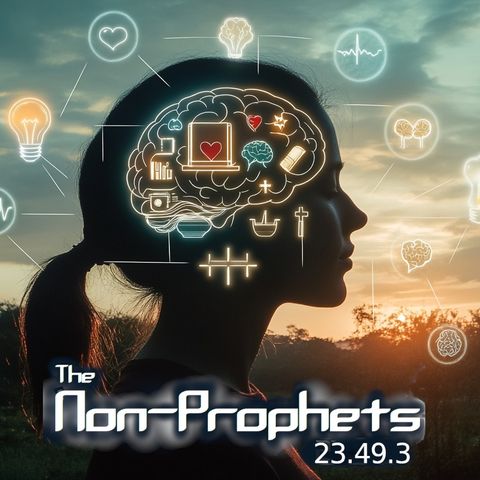
This episode of The Non-Prophets explores the intricate relationship between belief, delusion, and religious convictions. Hosted by Eli Slack, the discussion is prompted by an article from The Conversation by Michael Connors and Peter Hallagan, examining whether beliefs and delusions share common psychological roots. The article highlights that the primary difference between the two lies not in the mental process of formation but in the number of adherents, challenging our perceptions of "normal" beliefs versus delusional thinking.
The panel delves into a case study of a woman experiencing postpartum psychosis, whose delusions were shaped by interpreting ordinary stimuli in the context of her personal biases. This underscores a universal mechanism: beliefs, whether true or false, arise from subjective interpretations of sensory input filtered through emotional and cognitive biases. Eli emphasizes that religious beliefs, while not inherently indicative of mental instability, share no epistemological advantage over delusions.
The group critiques the article's lack of a clear definition of belief, a flaw that hampers meaningful discourse. Kelley asserts that beliefs are often embraced without critical thought, making them stagnant compared to an active pursuit of understanding. The panel also discusses societal double standards—other religions are dismissed as myths, while Christianity often escapes such scrutiny due to its dominant cultural presence.
Aaron and Kelley explore how psychology struggles to distinguish beliefs from delusions, suggesting that the objective truth—or lack thereof—defines the difference. Aaron provocatively argues that religion meets the criteria for delusion, as it lacks verifiable evidence, yet garners social acceptance when widely shared. Kelley supports this by highlighting how belief systems solidify when critical thought ceases.
The conversation concludes with reflections on societal norms and the dangers of uncritically accepted beliefs. While respecting individual faiths, the panel underscores the value of skepticism and evidence-based reasoning in navigating the complexities of belief and delusion.
The Non-Prophets, Episode 23.49.3 featuring Jimmy Jr., Kelley Laughlin, Aaron Jensen and Eli Slack
Become a supporter of this podcast: https://www.spreaker.com/podcast/the-non-prophets--3254964/support.
Información
| Autor | Atheist Community of Austin |
| Organización | Atheist Community of Austin |
| Página web | - |
| Etiquetas |

Copyright 2026 - Spreaker Inc. an iHeartMedia Company

Comentarios